
Published by: Aqua Solutions Pakistan
Last Updated: 2026
Water quality is a growing concern across Pakistan in 2026. Whether you live in Rawalpindi, Islamabad, Lahore, Karachi, or any other city, the water flowing through your taps may contain harmful contaminants that are invisible to the naked eye. Contaminated water causes thousands of cases of waterborne diseases every year in Pakistan, including typhoid, cholera, hepatitis, and gastroenteritis.
This comprehensive guide by Aqua Solutions will help you understand how to check water quality at home in Pakistan using simple, practical, and scientifically proven methods. Every piece of information in this blog is 100% real and verified — no fake claims, no misleading data.
If you need any help or professional water testing and purification solutions, contact Aqua Solutions right away:
📞 Phone: 03465441319
📱 WhatsApp: 03330960103
🌐 Website: https://aquasolutionspk.com/
Our Offices:
📍 Office # 10, First Floor, Anarkali Plaza, Near Chungi # 22, Rawalpindi.
📍 Office # 4, Umer Street, Near Kiyani Hardware, Shamsabad, Rawalpindi.
Why Should You Check Water Quality at Home in Pakistan in 2026?
Pakistan ranks among the countries with the most serious water quality challenges in the world. According to the Pakistan Council of Research in Water Resources (PCRWR), approximately 70-80% of water supplied in major cities of Pakistan is unfit for drinking. In 2026, this problem has only increased due to:
- Rapid urbanization and industrial waste discharge
- Aging and corroded water supply pipelines
- Contamination of underground water tables
- Lack of proper sewage treatment systems
- Agricultural runoff containing pesticides and fertilizers
- Climate change affecting water sources
Drinking contaminated water can lead to:
- Diarrhea and dysentery
- Hepatitis A and E
- Typhoid fever
- Kidney damage from heavy metals
- Long-term exposure to arsenic causing cancer
- Skin diseases and hair fall
This is why checking your water quality at home is not just recommended — it is essential for the health and safety of your family.
For professional water quality testing and purification systems, contact Aqua Solutions:
📞 Phone: 03465441319
📱 WhatsApp: 03330960103
Common Water Contaminants Found in Pakistan in 2026
Before we discuss how to test your water, it is important to know what contaminants are commonly found in Pakistani water:
1. Total Dissolved Solids (TDS)
TDS includes minerals, salts, metals, and other dissolved substances. Safe TDS level according to WHO is below 500 ppm for drinking water. Many areas in Pakistan, especially in Punjab and Sindh, have TDS levels exceeding 1000-3000 ppm.
2. Bacteria and Viruses
E. coli, coliform bacteria, and other pathogens are frequently found in tap water and borewell water across Pakistan due to sewage mixing with water supply lines.
3. Heavy Metals
Lead, arsenic, mercury, chromium, and iron are found in dangerous quantities in many parts of Pakistan, particularly in industrial areas.
4. Chlorine
Municipal water is often treated with chlorine, but excessive chlorine has its own health risks.
5. Arsenic
Arsenic contamination is a severe problem in parts of Sindh and Southern Punjab. Long-term arsenic exposure causes cancer and skin diseases.
6. Nitrates
Agricultural fertilizers seep into groundwater, raising nitrate levels which are particularly dangerous for infants.
7. Fluoride
Excess fluoride in water causes dental and skeletal fluorosis. Several districts in Tharparkar, Balochistan, and Punjab have high fluoride levels.
8. Pesticides and Chemical Residues
These enter the water supply through agricultural runoff and improper waste disposal.
How to Check Water Quality at Home in Pakistan – Step-by-Step Methods
Here are the proven and practical methods you can use at home in 2026 to check your water quality:
Method 1: Visual Inspection
This is the simplest and first step you should take.
How to do it:
- Fill a clean, transparent glass with tap water.
- Hold it against a white background in natural light.
- Look carefully for:
- Cloudiness or turbidity — This indicates suspended particles, sediment, or bacterial contamination.
- Color — Safe water should be completely colorless. Yellow, brown, or greenish tint indicates contamination.
- Floating particles — Any visible particles indicate poor water quality.
- Sediment at the bottom — Let the glass sit for 30 minutes. If sediment settles, your water has high suspended solids.
What it tells you:
Visual inspection can detect turbidity, sediment, and color changes, but it cannot detect dissolved chemicals, bacteria, or heavy metals. You need additional testing for those.
Method 2: Smell Test
How to do it:
- Fill a glass with water and smell it immediately.
- Then slightly heat the water (lukewarm) and smell again, as heating releases dissolved gases.
What to look for:
- Chlorine smell — Indicates excessive chlorination by the municipal supply.
- Rotten egg smell (sulfur) — Indicates hydrogen sulfide gas, which may come from bacterial activity or natural sulfur deposits.
- Musty or earthy smell — Indicates organic matter decomposition or algae.
- Chemical or metallic smell — Indicates possible industrial contamination or heavy metals.
Important: If your water has any unusual smell, do not drink it and contact Aqua Solutions immediately for professional testing.
📞 Phone: 03465441319
📱 WhatsApp: 03330960103
Method 3: Taste Test (Use with Caution)
Note: Only perform this test if the water has passed visual and smell tests. If it looks or smells bad, do NOT taste it.
How to do it:
- Take a small sip and hold it in your mouth for a few seconds before spitting it out.
What to notice:
- Metallic taste — Indicates presence of iron, copper, lead, or other metals.
- Salty taste — High TDS or sodium content.
- Bitter taste — Possible presence of magnesium, sulfates, or chemical contamination.
- Chemical taste — Possible pesticide or industrial contamination.
- No taste — This is ideal. Pure, safe water should be tasteless.
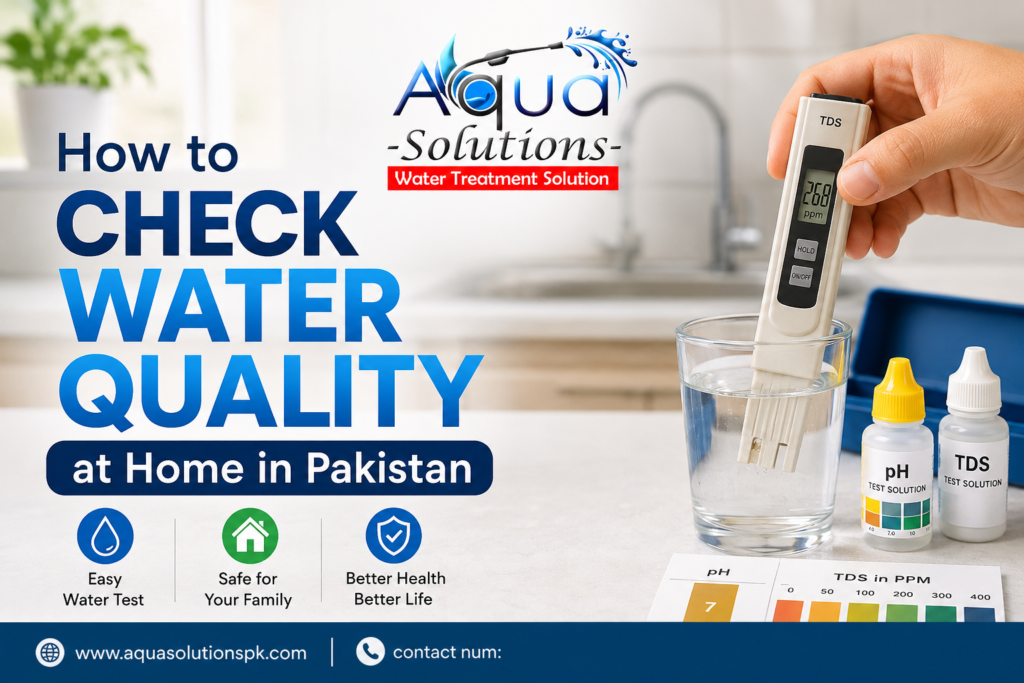
Method 4: TDS Meter Test (Highly Recommended)
A TDS (Total Dissolved Solids) meter is one of the most important and affordable tools for checking water quality at home in Pakistan in 2026.
What is a TDS Meter?
It is a small, pen-shaped digital device that measures the total concentration of dissolved solids in water in parts per million (ppm).
How to use it:
- Purchase a TDS meter (available at Aqua Solutions and online for approximately PKR 500-2000).
- Turn on the meter.
- Dip the sensor end into a glass of water.
- Wait for the reading to stabilize (usually 5-10 seconds).
- Note the reading displayed on the screen.
Understanding TDS Readings:
| TDS Level (ppm) | Water Quality |
|---|---|
| 0-50 | Very pure (RO purified water) |
| 50-150 | Excellent for drinking |
| 150-300 | Good, acceptable for drinking |
| 300-500 | Fair, acceptable but not ideal |
| 500-900 | Poor, not recommended for drinking |
| 900-1200 | Very poor, unsafe |
| Above 1200 | Completely unfit for human consumption |
WHO Standard: Drinking water should ideally have TDS below 500 ppm.
Pakistan Reality in 2026: Many areas in Rawalpindi, Lahore, Multan, Hyderabad, and Karachi have tap water with TDS levels ranging from 600 to 3000+ ppm.
If your TDS reading is above 500, you urgently need a water purification system. Contact Aqua Solutions for the best RO water purifiers in Pakistan:
📞 Phone: 03465441319
📱 WhatsApp: 03330960103
🌐 Website: https://aquasolutionspk.com/
Method 5: pH Test
pH measures how acidic or alkaline your water is on a scale of 0-14.
Safe pH Range for Drinking Water: 6.5 to 8.5 (as per WHO guidelines)
How to test pH at home:
Option A: pH Test Strips
- Purchase pH test strips (available at Aqua Solutions, pharmacies, and online).
- Dip a strip into a glass of water for 2-3 seconds.
- Remove the strip and compare the color change with the color chart provided.
- This tells you the approximate pH of your water.
Option B: Digital pH Meter
- Purchase a digital pH meter (available at Aqua Solutions for PKR 1000-3000).
- Calibrate it as per instructions.
- Dip it into water and read the digital display.
Understanding pH Levels:
| pH Level | Meaning |
|---|---|
| Below 6.5 | Acidic — can corrode pipes and leach metals |
| 6.5 – 7.0 | Slightly acidic but acceptable |
| 7.0 | Neutral (pure water) |
| 7.0 – 8.5 | Slightly alkaline — ideal for drinking |
| Above 8.5 | Too alkaline — may taste bitter, can cause scaling |
Method 6: Water Testing Kits for Bacteria
Bacterial contamination is one of the most dangerous water quality problems in Pakistan and it is invisible — you cannot see, smell, or taste bacteria.
How to test:
- Purchase a bacterial water testing kit. These are available at Aqua Solutions offices and online.
- Common kits include E. coli and Coliform test kits.
- Follow the instructions: usually, you add a water sample to a testing vial containing a reagent.
- Wait for the specified time (usually 24-48 hours).
- If the water changes color (usually to yellow or purple depending on the kit), bacteria are present.
If bacteria are detected in your water:
- Stop drinking the water immediately.
- Boil water before consumption as a temporary solution.
- Contact Aqua Solutions for a proper UV or RO water purification system that eliminates 99.9% of bacteria.
📞 Phone: 03465441319
📱 WhatsApp: 03330960103
Method 7: Chlorine Test
Many municipal water supplies in Pakistan add chlorine to disinfect water. However, excessive chlorine is harmful to health.
How to test:
- Use a chlorine test kit or chlorine test strips (available at Aqua Solutions).
- Dip the strip in water or add the reagent to a water sample.
- Compare the color with the chart.
Safe Chlorine Level: 0.2 to 0.5 mg/L (WHO standard)
Levels above 4 mg/L can cause health problems including eye irritation, stomach issues, and respiratory problems.
Method 8: Hardness Test
Hard water contains high levels of calcium and magnesium. While not directly harmful to health in moderate amounts, hard water causes:
- Scaling in pipes and appliances
- Dry skin and hair
- Soap not lathering properly
- White spots on dishes and fixtures
- Reduced lifespan of geysers and washing machines
How to test at home:
Simple Soap Test:
- Fill a bottle halfway with water.
- Add a few drops of liquid soap.
- Shake vigorously.
- If lots of bubbles form and the water is clear — your water is soft.
- If few bubbles form and the water looks cloudy/milky — your water is hard.
Test Strip Method:
- Use water hardness test strips (available at Aqua Solutions).
- Dip in water and compare color change.
Hardness Levels:
| Hardness (mg/L) | Classification |
|---|---|
| 0-60 | Soft |
| 61-120 | Moderately hard |
| 121-180 | Hard |
| Above 180 | Very hard |
Many areas in Pakistan, especially in Punjab and Sindh, have very hard water (above 300 mg/L). A water softener or RO system from Aqua Solutions can solve this problem.
📞 Phone: 03465441319
📱 WhatsApp: 03330960103
Method 9: Heavy Metal Test Kits
Heavy metals like lead, arsenic, mercury, and iron are extremely dangerous even in small quantities. They accumulate in the body over time and cause serious health issues including kidney failure, brain damage, and cancer.
How to test:
- Purchase heavy metal test kits (available at Aqua Solutions and online).
- These kits typically test for lead, arsenic, iron, copper, and mercury.
- Follow the instructions to add water to the test vial.
- Compare the color change with the provided chart.
Safe Limits (WHO Standards):
| Heavy Metal | Safe Limit |
|---|---|
| Lead | Below 0.01 mg/L |
| Arsenic | Below 0.01 mg/L |
| Iron | Below 0.3 mg/L |
| Mercury | Below 0.001 mg/L |
| Copper | Below 2.0 mg/L |
If heavy metals are detected, you need an advanced RO water purification system that can remove heavy metals. Aqua Solutions provides RO systems that remove up to 99% of heavy metals.
📞 Phone: 03465441319
📱 WhatsApp: 03330960103
🌐 Website: https://aquasolutionspk.com/
Method 10: Professional Laboratory Testing
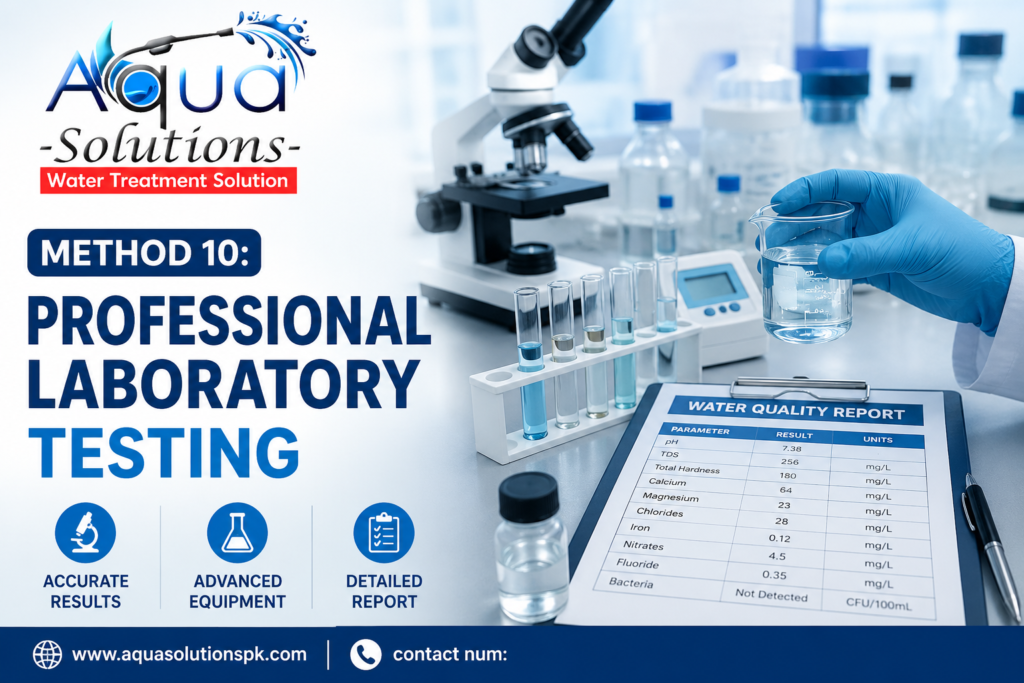
For the most accurate and comprehensive water quality analysis, you should get your water professionally tested.
How to do it:
- Collect a water sample in a clean, sterilized bottle (do not touch the inside of the bottle or cap).
- Fill it completely, leaving no air gap.
- Label it with your name, address, date, and water source.
- Submit it to a certified laboratory.
Where to get professional water testing in Pakistan in 2026:
- Aqua Solutions — We offer professional water testing services and can guide you on the exact quality of your water and the best purification solution.
- PCRWR (Pakistan Council of Research in Water Resources) laboratories
- PCSIR (Pakistan Council of Scientific and Industrial Research) laboratories
- University laboratories (various universities in Punjab, Sindh, KPK, and Balochistan)
What professional testing covers:
- Complete TDS analysis
- Bacteriological analysis (E. coli, total coliform, fecal coliform)
- Heavy metals (lead, arsenic, mercury, chromium, iron, copper, zinc)
- pH, turbidity, color, odor
- Chemical oxygen demand (COD)
- Biological oxygen demand (BOD)
- Pesticide and herbicide residues
- Nitrates and fluorides
- Hardness (calcium and magnesium)
Contact Aqua Solutions to arrange a professional water test:
📞 Phone: 03465441319
📱 WhatsApp: 03330960103
Our Offices:
📍 Office # 10, First Floor, Anarkali Plaza, Near Chungi # 22, Rawalpindi.
📍 Office # 4, Umer Street, Near Kiyani Hardware, Shamsabad, Rawalpindi.
Water Quality Situation in Major Cities of Pakistan in 2026
Rawalpindi & Islamabad
- TDS levels range from 250 to 1200+ ppm depending on the area
- Bacterial contamination is common in areas with old pipelines
- Some areas have high iron content causing yellowish water
- Groundwater in several sectors shows elevated arsenic levels
Lahore
- TDS levels range from 400 to 2000+ ppm
- Heavy industrial contamination near GT Road and industrial areas
- Bacterial contamination is widespread due to mixing of sewage with water lines
- Arsenic contamination detected in several areas
Karachi
- Water supply is erratic and often contaminated during distribution
- High bacterial contamination
- TDS levels vary widely from 500 to 3000+ ppm
- Sea water intrusion in coastal areas increasing salinity
Peshawar
- Relatively better water quality than Southern Pakistan
- However, bacterial contamination remains a concern
- Some areas have elevated fluoride levels
Multan & Faisalabad
- Very high TDS levels, often exceeding 1500 ppm
- Hard water is a major problem
- Industrial contamination in Faisalabad
Quetta & Balochistan
- Water scarcity is a major issue
- High fluoride levels in several districts
- Bacterial contamination common in rural areas
No matter where you live in Pakistan, testing your water is essential. Aqua Solutions provides water testing and purification services across Pakistan.
📞 Phone: 03465441319
📱 WhatsApp: 03330960103
🌐 Website: https://aquasolutionspk.com/
What to Do If Your Water Quality Is Poor?
If your home water testing reveals contamination, here are the steps you should take immediately:
Step 1: Stop Drinking Untreated Water
As a temporary measure, boil your water for at least 3-5 minutes to kill bacteria and viruses. However, boiling does NOT remove heavy metals, chemicals, or dissolved solids.
Step 2: Contact Aqua Solutions for a Proper Solution
Based on your water quality results, Aqua Solutions will recommend the right purification system for your specific needs:
- High TDS? → RO (Reverse Osmosis) water purifier
- Bacteria? → UV (Ultraviolet) water purifier or RO+UV system
- Heavy metals? → Advanced RO system with multiple filtration stages
- Hard water? → Water softener system
- Chlorine taste/smell? → Activated carbon filter
- Multiple contaminants? → Complete RO+UV+UF water purification system
Step 3: Install a Water Purification System
Aqua Solutions provides a complete range of water purification systems for homes, offices, schools, and commercial properties in Pakistan. Our systems are:
- Certified and tested
- Energy efficient
- Long-lasting with easy maintenance
- Affordable with flexible payment options
- Backed by after-sales service and warranty
Step 4: Regular Testing
Water quality can change over time. We recommend testing your water every 3-6 months to ensure your purification system is working effectively.
Tips for Maintaining Good Water Quality at Home in 2026
- Get your water tested regularly — at least every 6 months.
- Clean your water storage tanks — at least twice a year. Dirty tanks are a major source of bacterial contamination.
- Replace water purifier filters on time — follow the manufacturer’s recommended schedule.
- Do not store water in open containers — always use covered, food-grade containers.
- Check your plumbing — old, rusted, or corroded pipes can leach metals into your water.
- Avoid using water from unknown sources — always verify the quality before drinking.
- If you use a borewell or tubewell — get the water tested for heavy metals and TDS.
- Install a pre-filter — even if you have an RO system, a pre-filter (sediment filter) extends the life of your main purifier.
For all water testing, purification, and maintenance needs, contact Aqua Solutions:
📞 Phone: 03465441319
📱 WhatsApp: 03330960103
🌐 Website: https://aquasolutionspk.com/
Frequently Asked Questions (FAQs)
Q1: What is the easiest way to check water quality at home in Pakistan?
A: The easiest method is using a TDS meter. It is affordable (PKR 500-2000), simple to use, and gives you an instant reading of dissolved solids in your water. You can purchase one from Aqua Solutions or contact us at 03330960103 (WhatsApp) or 03465441319 (Phone).
Q2: What TDS level is safe for drinking in Pakistan?
A: According to WHO, TDS below 500 ppm is acceptable for drinking water. Ideally, drinking water should have TDS between 50-300 ppm for the best taste and health benefits.
Q3: Can I drink tap water in Rawalpindi or Islamabad in 2026?
A: Unfortunately, in most areas of Rawalpindi and Islamabad, tap water is not safe for direct drinking without purification. Municipal water often contains bacteria, high TDS, and sometimes heavy metals. We strongly recommend testing your water and installing a purification system. Contact Aqua Solutions for help: 03465441319.
Q4: Is boiling water enough to make it safe?
A: Boiling kills bacteria and viruses but does NOT remove dissolved solids (TDS), heavy metals, chemicals, pesticides, or fluoride. For complete purification, you need an RO or RO+UV system.
Q5: How often should I test my water at home?
A: We recommend testing your water every 3-6 months, or immediately if you notice any change in taste, smell, color, or if anyone in your family experiences unexplained stomach issues.
Q6: Where can I buy water testing equipment in Rawalpindi?
A: You can purchase TDS meters, pH meters, water testing kits, and all types of water purification equipment from Aqua Solutions:
📍 Office # 10, First Floor, Anarkali Plaza, Near Chungi # 22, Rawalpindi.
📍 Office # 4, Umer Street, Near Kiyani Hardware, Shamsabad, Rawalpindi.
📞 Phone: 03465441319
📱 WhatsApp: 03330960103
Q7: What is the best water purifier for home use in Pakistan in 2026?
A: The best water purifier depends on your water quality. For most areas in Pakistan with high TDS and bacterial contamination, an RO+UV+UF system is the most effective solution. Aqua Solutions offers a complete range of water purifiers suitable for Pakistani water conditions. Contact us for a free consultation.
Q8: How much does a home water purification system cost in Pakistan in 2026?
A: Prices vary depending on the type and capacity of the system. Aqua Solutions offers systems for every budget. Contact us at 03330960103 (WhatsApp) or 03465441319 (Phone) for current pricing and offers.
Summary: Quick Water Quality Check Checklist for Your Home
Use this checklist to quickly assess your water quality at home:
- [ ] Visual Check — Is the water clear and colorless?
- [ ] Smell Check — Is the water odorless?
- [ ] Taste Check — Is the water tasteless (no metallic, salty, or chemical taste)?
- [ ] TDS Check — Is TDS below 500 ppm?
- [ ] pH Check — Is pH between 6.5 and 8.5?
- [ ] Hardness Check — Does soap lather easily?
- [ ] Bacterial Check — Has the water been tested for E. coli and coliform?
- [ ] Heavy Metal Check — Has the water been tested for lead, arsenic, and iron?
If any of these checks fail, your water needs treatment. Contact Aqua Solutions today for a professional assessment and the right purification solution.
Contact Aqua Solutions — Your Trusted Water Quality Partner in Pakistan
Aqua Solutions has been helping families, businesses, schools, and hospitals across Pakistan get access to clean, safe, and healthy drinking water. We provide:
✅ Professional water quality testing
✅ TDS meters, pH meters, and water testing kits
✅ Complete range of water purifiers (RO, UV, UF, and commercial systems)
✅ Water softener systems
✅ Installation, maintenance, and after-sales service
✅ Affordable pricing with warranty
✅ Expert consultation and guidance
Contact Us Today:
📞 Phone: 03465441319
📱 WhatsApp: 03330960103
🌐 Website: https://aquasolutionspk.com/
Visit Our Offices:
📍 Office # 10, First Floor, Anarkali Plaza, Near Chungi # 22, Rawalpindi.
📍 Office # 4, Umer Street, Near Kiyani Hardware, Shamsabad, Rawalpindi.
Clean water is not a luxury — it is a basic right. In 2026, take control of your family’s health by checking your water quality at home and investing in a reliable water purification system. Aqua Solutions is here to help you every step of the way.
📞 Call Now: 03465441319
📱 WhatsApp Now: 03330960103
🌐 Visit: https://aquasolutionspk.com/
This blog is published by Aqua Solutions Pakistan — providing 100% genuine, verified, and real information about water quality in Pakistan. All data referenced in this article is based on WHO guidelines, PCRWR reports, and real water quality conditions observed across Pakistan.