Industrial RO Plant in Pakistan — Complete Guide (2026)
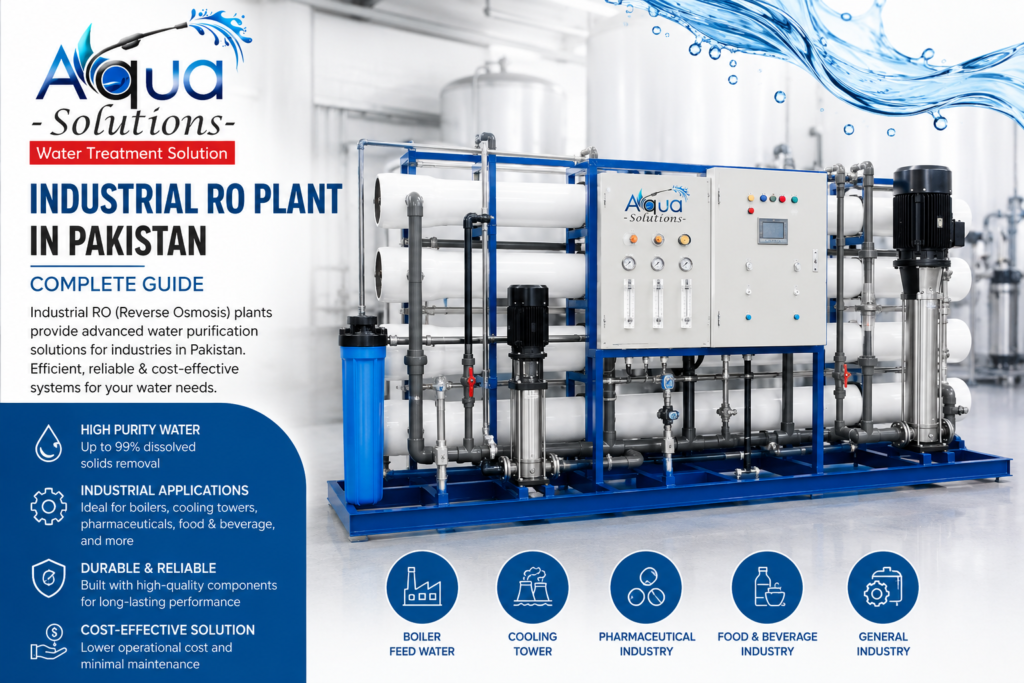
Your Trusted Partner for Clean Water Solutions Across Pakistan Water scarcity and water contamination have become two of the most pressing challenges facing Pakistan in 2026. Whether you operate a factory, a hospital, a housing society, a pharmaceutical company, or a food processing unit, access to clean and purified water is no longer optional — it is a fundamental necessity. This is where Industrial RO (Reverse Osmosis) Plants step in as a game-changing solution. If you are searching for reliable, high-performance, and cost-effective industrial RO plants in Pakistan, you have landed on the right page. Aqua Solutions has been at the forefront of delivering world-class water purification systems across the country. In this comprehensive guide for 2026, we will walk you through everything you need to know about industrial RO plants — from how they work to why they matter, from choosing the right capacity to installation and maintenance. For immediate consultation or pricing, contact Aqua Solutions right now: 📱 WhatsApp: 0333-0960103📞 Phone: 0346-5441319 🌐 Website: https://aquasolutionspk.com/ What Is an Industrial RO Plant? An Industrial Reverse Osmosis (RO) Plant is a large-scale water purification system that uses semi-permeable membranes to remove dissolved salts, minerals, bacteria, viruses, heavy metals, and other harmful contaminants from water. Unlike domestic RO systems that produce a few liters per hour, industrial RO plants are designed to treat thousands of liters of water every hour, making them suitable for commercial and industrial applications. The reverse osmosis process works by applying high pressure to push water through specialized membranes. These membranes have microscopic pores that allow water molecules to pass through while blocking contaminants. The result is clean, safe, and purified water that meets international quality standards. Need an industrial RO plant for your business? Call Aqua Solutions today: 📱 WhatsApp: 0333-0960103📞 Phone: 0346-5441319 Why Does Pakistan Need Industrial RO Plants in 2026? Pakistan’s water crisis has deepened significantly. According to recent reports in 2026, the country continues to face a severe water quality crisis. Here are the key reasons why industrial RO plants have become more important than ever: 1. Deteriorating Groundwater Quality Across Punjab, Sindh, Balochistan, and KPK, groundwater sources have become heavily contaminated with Total Dissolved Solids (TDS), arsenic, fluoride, and nitrates. In many industrial areas of Lahore, Faisalabad, Karachi, and Rawalpindi, the TDS levels in groundwater exceed 1500–5000 ppm, making it completely unfit for consumption or industrial use without proper treatment. 2. Strict Government Regulations In 2026, the Pakistan Environmental Protection Agency (Pak-EPA) and provincial environmental agencies have tightened regulations regarding wastewater discharge and water quality standards for industries. Factories and commercial establishments that fail to treat their water face heavy fines and potential shutdowns. 3. Growing Industrial Demand Pakistan’s industrial sector — including textiles, pharmaceuticals, food and beverage, dairy, and electronics — requires large volumes of purified water daily. Only industrial-grade RO plants can meet these high-volume demands efficiently and reliably. 4. Public Health Concerns Waterborne diseases such as hepatitis, typhoid, cholera, and gastroenteritis continue to affect millions of Pakistanis every year. For hospitals, schools, housing societies, and public water supply projects, industrial RO plants provide a proven and trusted method to ensure safe drinking water. 5. Cost-Effectiveness Over Time While the initial investment in an industrial RO plant may seem significant, the long-term savings are substantial. Businesses save money by reducing their dependence on water tankers, bottled water, and expensive maintenance caused by using hard or contaminated water in boilers, cooling towers, and manufacturing processes. Aqua Solutions can help you choose the right RO system for your needs. Get in touch now: 📱 WhatsApp: 0333-0960103📞 Phone: 0346-5441319 How Does an Industrial RO Plant Work? — Step-by-Step Process Understanding how an industrial RO plant works will help you make an informed decision. Here is a detailed step-by-step breakdown of the water treatment process: Step 1: Raw Water Collection Water is drawn from the source — whether it is a borehole, well, river, canal, or municipal supply — and stored in a raw water storage tank. Step 2: Pre-Filtration (Sediment Removal) The water passes through multi-grade filters (MGF) and activated carbon filters (ACF) to remove suspended particles, sediment, chlorine, organic matter, and unpleasant odors or tastes. Step 3: Water Softening (If Required) For water with high hardness levels, a water softener is used to remove calcium and magnesium ions, which can damage RO membranes and reduce their lifespan. Step 4: Antiscalant Dosing A chemical antiscalant is injected into the water to prevent mineral scale buildup on the RO membranes. This step is critical for extending membrane life and maintaining optimal performance. Step 5: Micron Filtration The water passes through 5-micron or 1-micron cartridge filters to remove any remaining fine particles before entering the RO membranes. Step 6: High-Pressure Pumping A high-pressure pump (typically a Grundfos, CNP, or equivalent) pushes the pre-treated water through the RO membranes at the required pressure (usually 150–250 psi for brackish water and up to 1000 psi for seawater). Step 7: Reverse Osmosis Membrane Filtration This is the heart of the system. The semi-permeable RO membranes (commonly from brands like Filmtec/DuPont, Hydranautics, or Toray) reject 95–99% of dissolved salts, heavy metals, bacteria, and viruses. The water is separated into two streams: Step 8: Post-Treatment Depending on the application, post-treatment may include UV sterilization, ozone treatment, pH adjustment, or re-mineralization to ensure the water meets specific quality requirements. Step 9: Storage and Distribution The treated water is stored in a clean water storage tank and distributed through a dedicated pipeline network to the point of use. Want to see this system in action? Visit Aqua Solutions or request a free consultation: 📱 WhatsApp: 0333-0960103📞 Phone: 0346-5441319 Types of Industrial RO Plants Available at Aqua Solutions At Aqua Solutions, we offer a wide range of industrial and commercial RO plants to meet every requirement. Here is a detailed overview of the systems available in 2026: 1. Small Commercial RO Plants (250–1,000 LPH) 2. Medium Commercial RO Plants (1,000–5,000 LPH) 3. Large Industrial RO Plants (5,000–50,000 LPH) 4. Ultra-Large Industrial RO
Industrial RO Plant in Pakistan — Complete Guide (2026) Read More »